
SOC 2 Password and Access Control Requirements Explained
Build a compliant 2026 small business password policy with NIST length rules, password manager rollout steps, and MFA enforcement checklists.
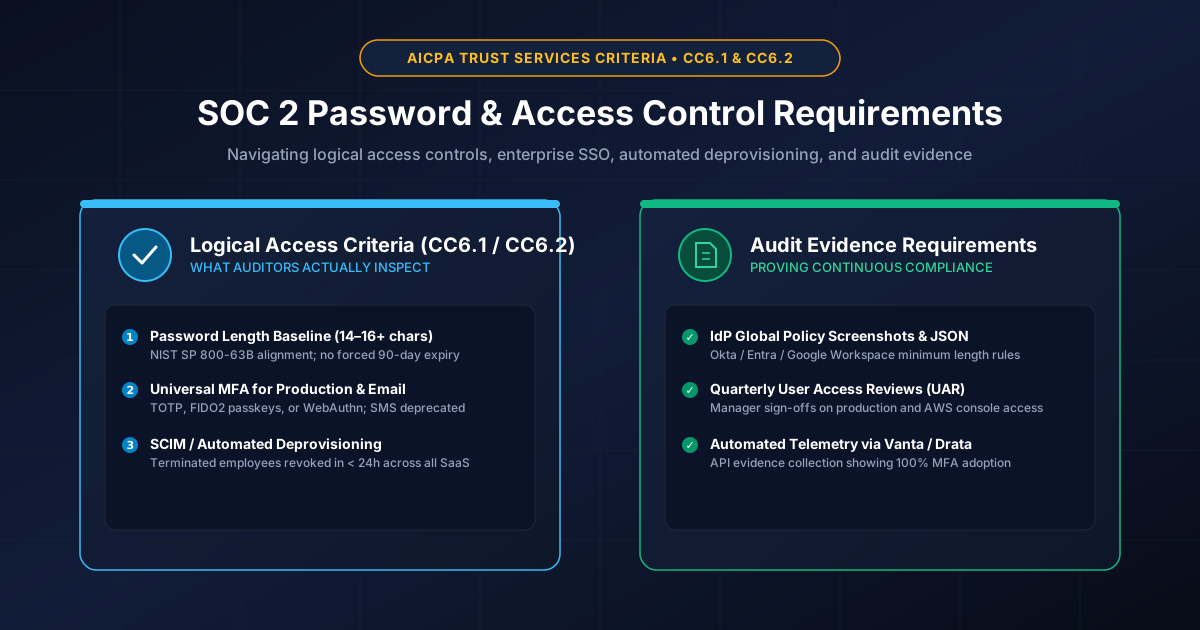
Figure 1.1: SOC 2 Type II Trust Services Criteria CC6.1 & CC6.2 logical access control standards.
Quick Answer: Unlike rigid legacy compliance frameworks, SOC 2 (System and Organization Controls 2) does not mandate a prescriptive character count; instead, under the AICPA Trust Services Criteria CC6.1 (Logical Access Controls) and CC6.2 (User Registration & Access Deprovisioning), auditors require organizations to enforce risk-based authentication baselines. In 2026, passing a SOC 2 Type II audit requires enforcing a minimum 14-to-16-character password baseline, mandatory Multi-Factor Authentication (MFA) across all corporate identity providers (IdP) and cloud infrastructure, automated SCIM deprovisioning within 24 hours of employee departure, and documented quarterly user access reviews.
The Trust Services Criteria: Deconstructing CC6.1, CC6.2, and CC6.3
In a SOC 2 Type II assessment, an independent CPA auditor does not just check whether you have a written password policy document; they test whether your controls were operating effectively across an evaluation window of 3 to 12 months. Three core criteria govern your authentication posture:
- CC6.1 — Logical Access Infrastructure: The entity implements logical access security software, infrastructure, and architectures over protected information assets to protect them from security events. This includes centralized Identity Providers (Okta, Microsoft Entra ID, Google Workspace) and role-based access control (RBAC).
- CC6.2 — User Registration, Access Modification, and Deprovisioning: Prior to issuing system credentials, the entity registers and authorizes new users. Crucially, access rights must be modified or revoked immediately upon job transfer or termination (typically enforced with an automated SLA of under 24 hours).
- CC6.3 — Least Privilege & Access Recertification: System access is granted based on the principle of least privilege. Organizations must conduct scheduled quarterly User Access Reviews (UAR) where department leads recertify that their direct reports require access to production databases, AWS consoles, and customer data.
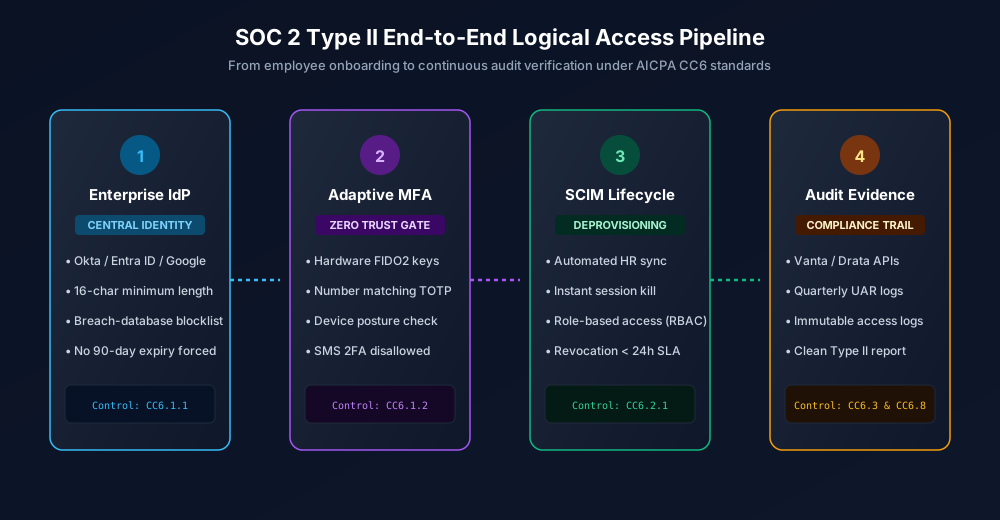
Figure 1.2: End-to-end SOC 2 Type II logical access control and continuous automated compliance pipeline.
Password Policy Baselines: The NIST SP 800-63B Shift
Historically, compliance teams enforced legacy password rules: arbitrary character mixing (uppercase, lowercase, number, special character) and forced 90-day password expiration. In modern SOC 2 assessments, auditors explicitly align with NIST SP 800-63B Digital Identity Guidelines:
- Length Over Complexity: Require a minimum of 14 to 16 characters for human users, and 24+ characters for administrative or root accounts. Length exponentially increases cryptographic keyspace and resists offline cracking.
- Eliminate Forced Expiration: Do NOT force arbitrary 90-day rotations unless there is credible evidence of a breach. Forced rotations lead to predictable substitutions (e.g.,
Spring2026!toSummer2026!). - Breach Database Screening: The IdP must automatically cross-reference new passwords against compromised credentials (such as Have I Been Pwned or proprietary threat-intel feeds) and reject breached passwords in real time.
- No Composition Rules: Allow users to generate natural multi-word passphrases with spaces or hyphens rather than forcing awkward character combinations that encourage sticky-note storage.
To assist employees in generating audit-proof credentials, provide them with our client-side, zero-knowledge Password Generator or Passphrase Generator, and verify policy strength using our offline Password Strength Checker.
Multi-Factor Authentication (MFA): Non-Negotiable Auditor Standard
Under CC6.1, a single password is never considered adequate for sensitive production systems. SOC 2 auditors test for 100% MFA adoption across:
- Corporate Email & SSO: Google Workspace, Microsoft 365, or Okta.
- Cloud & Server Infrastructure: AWS Console, Google Cloud Platform, Azure Portal, GitHub Enterprise, and SSH bastion servers.
- Production Databases & Internal Tools: Customer data portals, Datadog, Snowflake, and administrative panels.
Furthermore, the choice of MFA matters: SMS-based two-factor authentication is heavily flagged by auditors due to SIM-swap vulnerabilities. Standardize on hardware security keys (FIDO2 / YubiKey), WebAuthn passkeys (as detailed in our WebAuthn guide), or mobile authenticator apps with number matching (e.g., Okta Verify, 1Password, Microsoft Authenticator).
Audit Evidence Matrix: What SOC 2 Auditors Demand
To prepare your team for a smooth audit and avoid qualified opinions, gather evidence for each authentication control systematically:
| SOC 2 Control Domain | Audit Criteria | Required Implementation | Audit Evidence Required |
|---|---|---|---|
| Password Length Baseline | CC6.1.1 | 14–16+ character minimum enforced in IdP | IdP policy settings screenshot + JSON API export |
| Universal MFA Enforcement | CC6.1.2 | Mandatory TOTP / FIDO2; zero MFA exemptions | Active user list showing 100% MFA enrolled status |
| Offboarding Deprovisioning | CC6.2.1 | Automated SCIM revocation within 24 hours | Sample of terminated staff: HR exit timestamp vs IdP lock timestamp |
| Privileged Access Review | CC6.3.1 | Quarterly formal review of admin/prod rights | Signed ticket or UAR approval spreadsheet per quarter |
| Credential Storage & Vaults | CC6.1.4 | Enterprise password manager with zero-knowledge | 1Password / Bitwarden enterprise console roster showing 100% adoption |
Automating Compliance: Integrating Vanta, Drata, and Secureframe
Modern fast-growing SaaS companies no longer assemble manual screenshot binders for their auditors. Instead, continuous compliance platforms (such as Vanta, Drata, or Secureframe) connect via read-only APIs directly to your cloud infrastructure:
- Continuous IdP Scans: The platform pings your Okta or Google Workspace API every hour to verify that no user has disabled MFA or set a non-compliant password.
- Automated Offboarding Alerts: If an employee is marked terminated in your HR system (Rippling, Gusto, BambooHR) and their AWS or GitHub access remains active after 24 hours, an automated compliance alert triggers before your auditor discovers the lapse.
- Continuous Evidence Locker: Screenshots, pull-request peer reviews, and backup verification logs are ingested and time-stamped continuously throughout your 12-month SOC 2 Type II audit window.
For more regulatory security requirements, explore our comprehensive breakdown on HIPAA Password Compliance Requirements and our guide to Small Business Password Policies.
Frequently Asked Questions
Does SOC 2 require 90-day password expiration?
No. In fact, modern SOC 2 auditors discourage forced 90-day password rotation because it leads users to choose predictable patterns (e.g., changing Winter2025! to Spring2025!). Following NIST SP 800-63B, auditors prefer 14-to-16+ character passphrases paired with mandatory MFA and real-time breached-password screening.
Can an employee use SMS for their SOC 2 MFA requirement?
While some auditors technically accept SMS in legacy environments, top-tier auditors (Big 4 and modern tech auditors) heavily discourage or flag SMS 2FA due to SIM-swapping and SS7 interception vulnerabilities. Best practice is to enforce TOTP authenticator apps (Okta Verify, Microsoft Authenticator) or FIDO2 WebAuthn hardware passkeys.
What is the required SLA for deprovisioning access when an employee leaves?
Most SOC 2 auditors look for access to be revoked within 24 hours of employee departure. Organizations with automated SCIM integration between their HR information system (HRIS) and Identity Provider achieve revocation in minutes, providing definitive audit proof.
What happens if our company fails an access control test during a Type II audit?
If an auditor discovers that an employee was not deprovisioned within the SLA or was missing MFA, it results in an audit "exception" in the final SOC 2 Type II report. While one minor exception may not prevent issuing the report, systematic access control failures can lead to a qualified opinion, severely harming enterprise sales deals.
Related password security guides
Best Password Practices for Small Businesses
A practical small business password safety guide covering password managers, MFA, shared accounts, staff changes, and admin access.
Bulk Password Generator Risks
Learn when bulk password generation is useful, when it creates risk, and how teams should handle many new passwords safely.
Business Password Safety Checklist
Use this practical password safety checklist to protect business email, admin accounts, cloud tools, freelancers, and shared access.
The tools work without analytics. Optional cookies help us understand page visits; passwords and form values are never collected.