
How Zero-Knowledge Architecture Protects Password Vaults During Server Breaches
Build a compliant 2026 small business password policy with NIST length rules, password manager rollout steps, and MFA enforcement checklists.
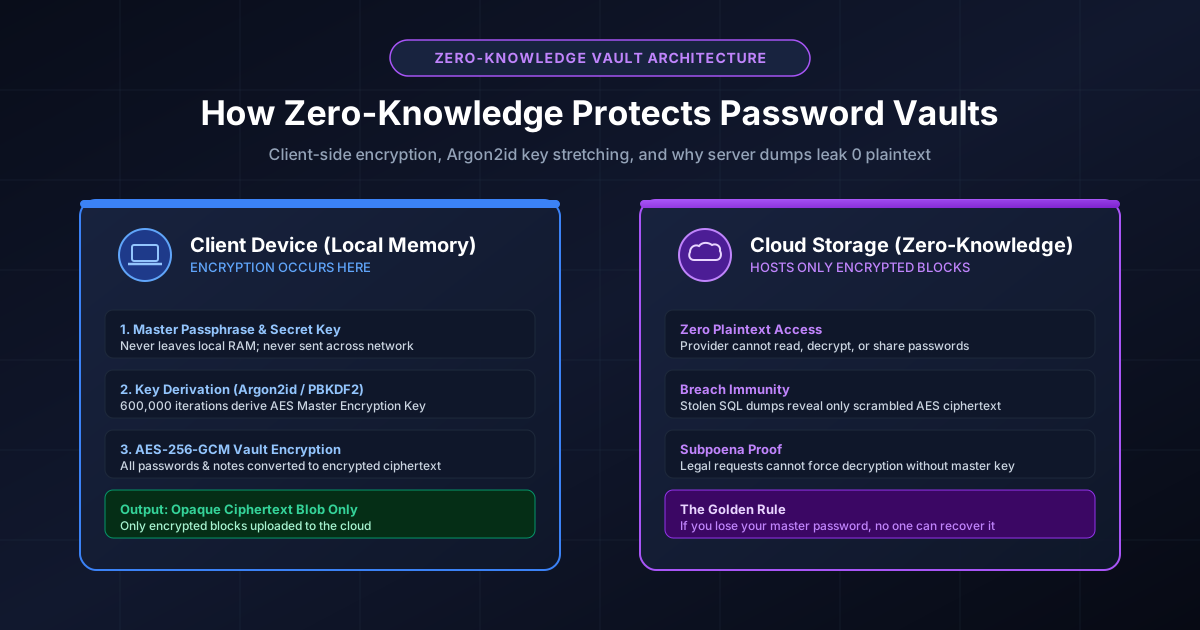
Figure 2.1: The Zero-Knowledge trust boundary: client-side plaintext encryption vs. unreadable server ciphertext.
Quick Answer: In a true Zero-Knowledge Architecture, encryption and decryption occur exclusively on your local device (phone, laptop, or browser extension). Your master passphrase and secret keys are never transmitted over the internet or stored on cloud servers. If the password manager provider suffers a catastrophic server breach or SQL database leak, the attackers steal only meaningless blobs of AES-256 ciphertext that cannot be decrypted without your local master password.
The Client-Side Cryptographic Boundary: Why Server Access Is Irrelevant
Traditional web applications (such as email providers or social networks) manage encryption on the server side: they hold the cryptographic keys and decrypt data in memory whenever an authorized user requests it. If that server is compromised, all user data is exposed in plaintext.
Reputable password managers (such as 1Password and Bitwarden) reverse this model through End-to-End Client-Side Zero-Knowledge Cryptography:
- Local Decryption: When you enter your master password, your device decrypts your vault entries directly in local Random Access Memory (RAM).
- Local Encryption: When you add a new login, credit card, or note, your device encrypts the item with AES-256-GCM before writing a single byte to the network.
- Cloud Blindness: The cloud database acts merely as an encrypted storage locker. The server administrators, database engineers, and cloud hosting providers possess zero mathematical ability to decrypt or inspect your passwords.
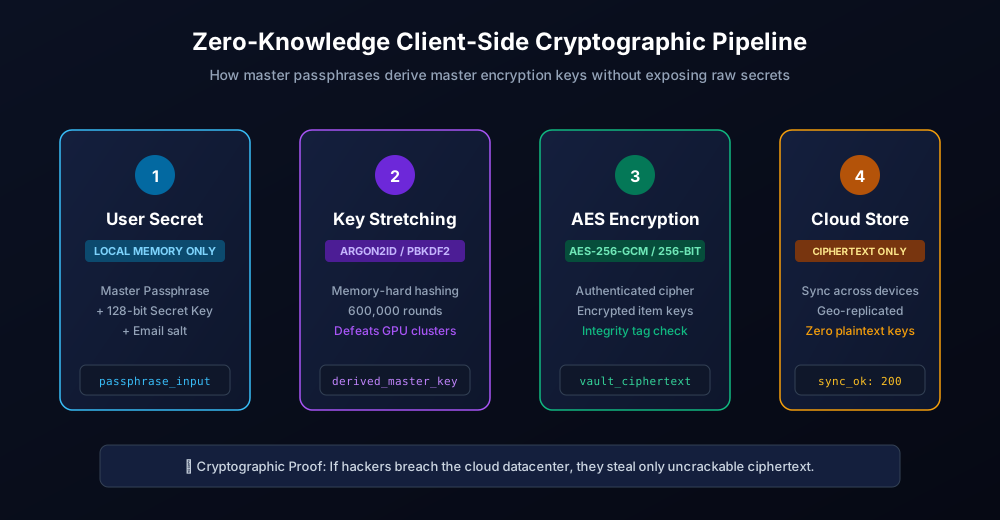
Figure 2.2: The four-stage zero-knowledge key derivation and symmetric encryption pipeline.
The 4-Stage Zero-Knowledge Cryptographic Pipeline
Modern zero-knowledge vaults transform your master passphrase into secure vault ciphertext through four rigorous layers:
1. Salted Memory-Hard Key Derivation (Argon2id & PBKDF2)
Your master passphrase is not used directly as an encryption key. Instead, the client software runs your passphrase through an intentionally slow, memory-hard Key Derivation Function (KDF):
- Argon2id: Winner of the Password Hashing Competition, Argon2id requires large allocations of RAM (e.g. 64 MB) and multiple execution threads, rendering high-speed parallel GPU and ASIC attacks financially unfeasible.
- PBKDF2-HMAC-SHA256: Standardized with high iteration counts (minimum 600,000 rounds recommended by OWASP).
This process produces a 256-bit Master Key. Because this computation happens on your hardware, an attacker attempting to brute-force a stolen vault must perform millions of memory-intensive calculations per candidate guess.
2. The Dual-Key Architecture (1Password Secret Key)
To defend against weak master passwords, advanced zero-knowledge architectures incorporate a secondary, locally stored 128-bit random token (such as 1Password's Secret Key). The Master Key is derived from both the user's memorized passphrase AND this 128-bit high-entropy secret. Even if a user picks a relatively short master password, the 128-bit secret key guarantees that brute-forcing the vault requires ^{128}$ operations, defying all known supercomputers.
3. Symmetric AES-256-GCM Encryption
The derived Master Key decrypts an individual, randomly generated Vault Key. Each login record inside the vault is encrypted with its own unique initialization vector (IV) using AES-256-GCM (Galois/Counter Mode). GCM provides authenticated encryption, guaranteeing that an attacker cannot tamper with or silently modify encrypted fields without triggering an immediate integrity failure.
4. Master Password Hash Separation
To authenticate you to the cloud server, the client does not send the derived Master Key. Instead, it runs the key through an additional cryptographic hash function (e.g., PBKDF2 or SHA-256) to produce an Authentication Hash. The server verifies this hash to grant access to download the encrypted blob, but the Authentication Hash cannot be reversed to discover the Master Key needed to decrypt the vault.
Real-World Case Study: What Happens When a Cloud Provider Is Breached?
| Architectural Layer | Traditional Cloud Service (Plaintext / Reversible) | Zero-Knowledge Vault (Bitwarden / 1Password) |
|---|---|---|
| Stolen Cloud Database Dump | Passwords, emails, and notes exposed immediately | Only uncrackable AES-256 ciphertext blobs captured |
| Compromised Cloud Admin Account | Rogue admin can read customer records | Admin sees only encrypted strings; cannot decrypt |
| Government Subpoena or Warrant | Provider compelled to hand over decrypted user data | Provider hands over encrypted blobs (Mathematically impossible to read) |
| User Forgets Master Password | Click "Forgot Password" to reset instantly | Total data loss unless emergency kit / recovery key exists |
The Single Vulnerability: Master Passphrase Entropy
Because zero-knowledge encryption shifts the entire security perimeter onto the user's master password, the mathematical strength of that passphrase is your only line of defense. If a threat actor steals an encrypted vault blob and the user chose a common 8-character password like Sunshine1!, the attacker can use GPU hash cracking rigs to test billions of dictionary combinations.
To guarantee that your zero-knowledge vault is completely unbreakable, your master passphrase must have at least 75 to 80 bits of Shannon entropy. Generate an uncrackable 5-word or 6-word Diceware passphrase using our dedicated Passphrase Generator, and test your credentials with our offline Password Strength Checker.
Frequently asked questions
Can customer support reset my master password if I forget it?
In a true zero-knowledge password manager, customer support cannot reset your password or recover your data because they do not possess your cryptographic keys. You must use an emergency recovery kit, account recovery key, or biometric backup to regain access.
Is my zero-knowledge vault safe if hackers steal the cloud server backup?
Yes. The cloud server stores only encrypted ciphertext. Even if an attacker downloads the entire database, they cannot read any usernames, passwords, or notes without performing an offline brute-force attack against your master passphrase, which is computationally infeasible for passphrases with 75+ bits of entropy.
Why does 1Password use a Secret Key in addition to a master password?
The 128-bit Secret Key adds 128 bits of true cryptographic entropy to your master passphrase. Even if you pick a relatively weak master password, combining it with the hardware-stored Secret Key ensures your vault ciphertext cannot be cracked by state-sponsored supercomputers.
How does a browser extension decrypt my passwords?
When you unlock the extension, it derives the Master Key from your master passphrase in local memory and decrypts your vault items locally. When you close the browser or lock the vault, the decryption keys are wiped from RAM.
Related password security guides
Best Password Practices for Small Businesses
A practical small business password safety guide covering password managers, MFA, shared accounts, staff changes, and admin access.
Bulk Password Generator Risks
Learn when bulk password generation is useful, when it creates risk, and how teams should handle many new passwords safely.
Business Password Safety Checklist
Use this practical password safety checklist to protect business email, admin accounts, cloud tools, freelancers, and shared access.
The tools work without analytics. Optional cookies help us understand page visits; passwords and form values are never collected.