
Credential Stuffing vs. Brute-Force vs. Password Spraying: What's the Difference?
Build a compliant 2026 small business password policy with NIST length rules, password manager rollout steps, and MFA enforcement checklists.
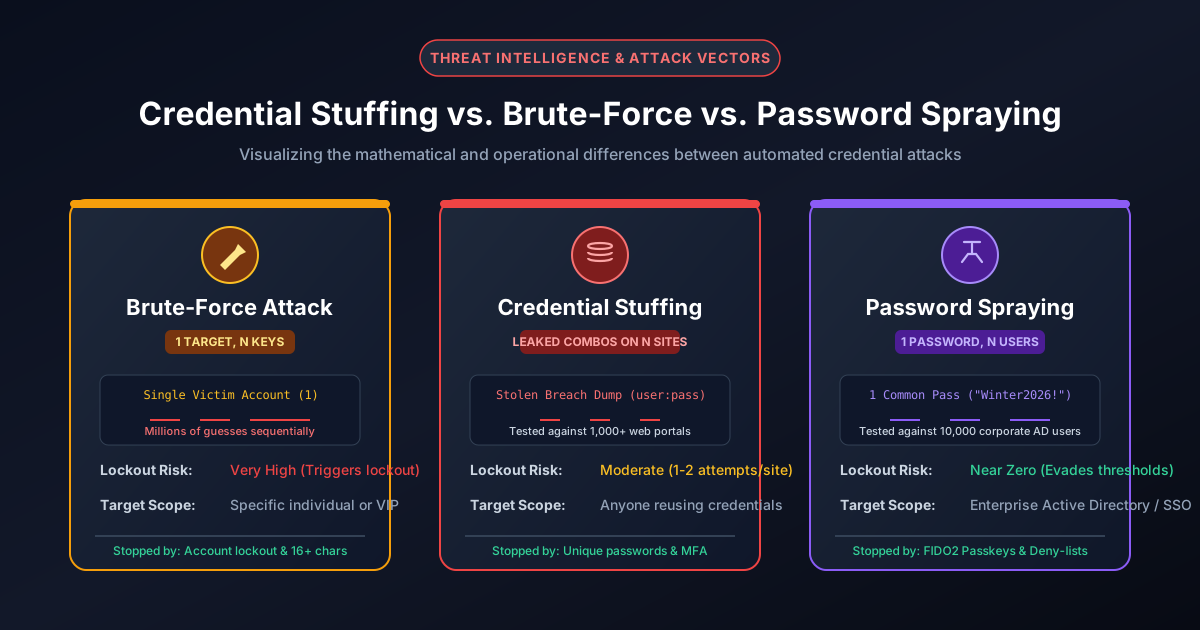
Figure 2.1: Architectural topology of the three primary automated credential attack vectors.
Quick Answer: A brute-force attack tests millions of password guesses against a single target account until one works; credential stuffing takes millions of stolen username-password combinations from past data breaches and tests them across thousands of other websites; and password spraying tests one or two common passwords (e.g., Company2026!) across thousands of user accounts within an organization to evade account lockout thresholds.
The Credential Attack Vector Taxonomy
Over 80% of corporate data breaches originate from compromised credentials. While media reports frequently categorize all account compromises under the umbrella term "hacking," automated credential attacks operate on fundamentally distinct mathematical formulas, adversary tooling, and evasion strategies.
Understanding the precise operational differences between brute-force, credential stuffing, and password spraying is essential for configuring effective firewalls, web application firewalls (WAFs), active directory policies, and user authentication baselines.
1. The Mechanics of a Pure Brute-Force Attack
In a pure brute-force attack (MITRE ATT&CK technique T1110.001), the adversary targets a single known identity (such as admin@company.com) and submits an exhaustive sequence of alphanumeric characters or dictionary words.
How the Math Works
The total possible combinations in an attack space is defined by $N^L$, where $N$ is the character set size and $L$ is password length. A simple 8-character lowercase password has ^8 \approx 208.8\text{ billion}$ combinations. On modern high-performance GPU rigs (such as 8x NVIDIA RTX 4090s running Hashcat), an attacker can compute unsalted MD5 hashes at over 100 billion guesses per second, exhausting the entire 8-character keyspace in under 3 minutes.
Why Pure Online Brute-Force Is Dead
While offline brute-force against stolen database dumps is devastating, online brute-force against live web portals is almost completely obsolete. Any modern web application implements an account lockout policy (e.g. locking the account after 5 consecutive incorrect attempts) or CAPTCHA challenge. If an attacker submits 5 failed passwords, the account freezes, ending the attack instantly.
2. Credential Stuffing: Weaponizing Human Password Reuse at Scale
Credential stuffing (MITRE ATT&CK technique T1110.004) is an automated attack that does not attempt to guess passwords. Instead, it weaponizes credentials that have already been proven correct.
The Breach Re-use Loophole
Billions of plaintext and cracked credential pairs from historical data breaches (such as LinkedIn, Dropbox, Adobe, and Combo List aggregations like "Collection #1") circulate on dark web forums and Telegram channels. Because over 65% of internet users reuse the exact same password across multiple websites, a password stolen from an insecure forum will frequently unlock that same user's PayPal, Netflix, Amazon, or corporate email account.
Automated Stuffing Toolkits and Residential Proxies
Threat actors deploy automated software suites (such as OpenBullet, SilverBullet, or custom Python bots) equipped with modular config files designed for specific target sites. To bypass Web Application Firewalls (WAFs) and IP rate limits, attackers route their requests through distributed residential proxy networks consisting of millions of compromised IoT devices and home routers. By submitting only one attempt per IP address, they simulate normal human traffic and achieve successful login conversion rates between 0.5% and 3%.
3. Password Spraying: Bypassing Enterprise Lockouts
Password spraying (MITRE ATT&CK technique T1110.003) is a specialized horizontal brute-force technique designed specifically to defeat Active Directory, Okta, and Azure AD / Entra ID lockout policies.
The Horizontal Inversion
Instead of guessing 100 passwords against 1 account (which immediately triggers lockout), password spraying guesses 1 common password against 10,000 corporate usernames.
Threat actors compile a list of employee email addresses via LinkedIn scraping and corporate directory enumeration. Then, using tools like MSOLSpray or DomainPasswordSpray, they test an overwhelmingly common enterprise password:
Winter2026!orAutumn2026!Welcome123!orPassword123!Company2026#(where "Company" matches the organization's name)
The script submits one attempt per user account, waits 35 minutes (resetting the corporate failed-login timer), and repeats the process with a second candidate password. Because no individual account ever exceeds the failed attempt threshold, security incident detection systems remain silent while the attacker gains valid domain access.
Comparison Matrix: The Three Credential Attack Vectors
| Attack Vector | Target Scope | Guess Velocity | Lockout Risk | Primary Attacker Tooling | Primary Countermeasure |
|---|---|---|---|---|---|
| Pure Brute-Force | 1 Specific Account | High (Millions/sec) | Extremely High (Triggered immediately) | Hashcat, John the Ripper, Hydra | Account Lockout & Rate Limiting |
| Credential Stuffing | Thousands of Services | Medium (Distributed) | Low (1-2 attempts per target site) | OpenBullet, SOCKS5 Residential Proxies | Unique Passwords & WAF Device Fingerprinting |
| Password Spraying | Entire Corporate Directory | Slow & Low (Evades detection) | Near Zero (Under lockout threshold) | MSOLSpray, Ruler, SprayingToolkit | Banned Password Lists & FIDO2 Passkeys |
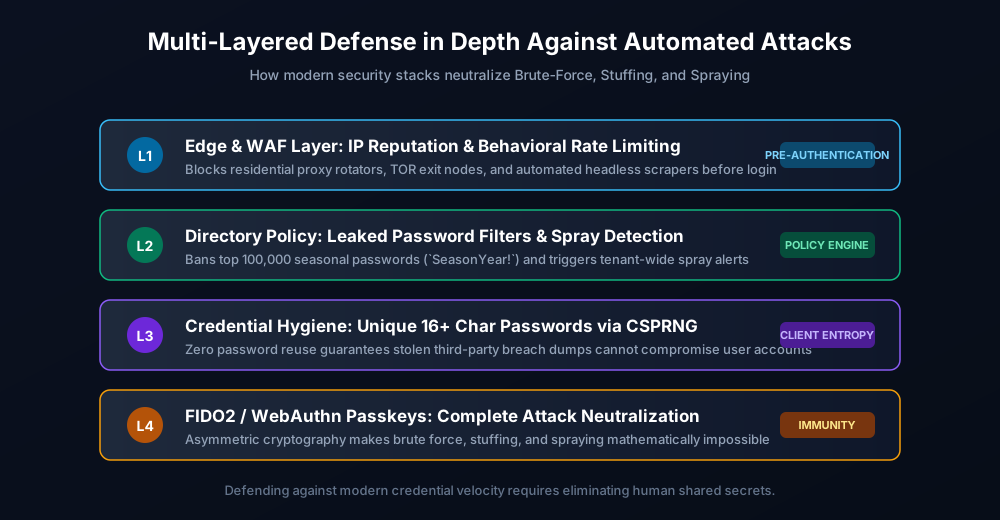
Figure 2.2: The four-layer defense-in-depth model that neutralizes all automated credential velocity.
How to Neutralize All Three Vectors: Multi-Layered Defense
No single security control can defend against all credential attacks simultaneously. Organizations must deploy a defense-in-depth framework:
1. Enforce Unique 16+ Character Passwords via Hardware CSPRNG
Credential stuffing is 100% reliant on password reuse. If every account in your organization utilizes a unique password generated by a cryptographically secure pseudo-random number generator, a data breach at a vendor or third-party service has zero correlation to your systems.
Use our dedicated 16-Character Password Generator (104.9 bits of entropy) to enforce the NIST SP 800-63B baseline across your team, and test existing credentials with our client-side Password Strength Checker.
2. Dynamic Password Deny-Lists
To eliminate password spraying, integrate dynamic password filters (such as Microsoft Entra Password Protection) that prevent employees from ever selecting predictable patterns, seasonal words, or terms derived from the company name.
3. Modern Phishing-Resistant MFA and FIDO2 Passkeys
Traditional SMS and push-notification multi-factor authentication can be bypassed via SIM swapping or MFA prompt fatigue. Transitioning to FIDO2 / WebAuthn Passkeys completely eliminates shared secrets, making brute-force, stuffing, and spraying mathematically impossible. Read our comprehensive Passkeys vs. Passwords Migration Guide to learn how asymmetric cryptography stops all credential attacks permanently.
Frequently asked questions
What is the key difference between password spraying and credential stuffing?
Credential stuffing uses known, stolen username and password pairs from prior data breaches and tests them across multiple websites where users might have reused passwords. Password spraying tests a single common password (such as "Winter2026!") across thousands of corporate user accounts within the same organization to avoid triggering account lockout thresholds.
Why don't account lockout policies prevent password spraying?
Account lockout policies typically lock an account after 3 to 5 consecutive failed attempts. Password spraying circumvents this by submitting only one attempt per account, waiting for the failed attempt window to reset (typically 30 minutes), and then submitting another attempt with a different password, never exceeding the threshold.
Can multi-factor authentication (MFA) stop credential stuffing?
Yes, MFA stops the majority of credential stuffing attacks because even if an attacker possesses the correct username and password, they cannot supply the second authentication factor. However, FIDO2 passkeys and hardware security keys are superior because they eliminate the underlying password entirely.
How do attackers prevent their IP addresses from being blocked during credential stuffing?
Threat actors use automated software that routes login attempts through vast networks of rotating residential and mobile proxies (compromised home routers and IoT devices). By distributing millions of requests across distinct residential IP addresses, each IP submits only one or two login attempts, making it indistinguishable from legitimate human traffic.
Related password security guides
Best Password Practices for Small Businesses
A practical small business password safety guide covering password managers, MFA, shared accounts, staff changes, and admin access.
Bulk Password Generator Risks
Learn when bulk password generation is useful, when it creates risk, and how teams should handle many new passwords safely.
Business Password Safety Checklist
Use this practical password safety checklist to protect business email, admin accounts, cloud tools, freelancers, and shared access.
The tools work without analytics. Optional cookies help us understand page visits; passwords and form values are never collected.